

The GWM Tank 500 PHEV has officially landed in Pakistan, marking a significant milestone as one of the country’s first locally assembled plug-in hybrid full-size SUVs. Priced at PKR 22.5 million, this imposing vehicle from Great Wall Motors (GWM) represents a bold statement in Pakistan’s premium SUV segment, directly challenging established players like the Toyota Fortuner and Land Cruiser Prado while offering something neither can match — genuine plug-in hybrid capability with substantial electric-only range.
Since its launch announcement in late January 2026, the Tank 500 PHEV has generated considerable buzz among Pakistani automotive enthusiasts and potential buyers. The overwhelming demand has already pushed delivery estimates from an initial 3–4 months to extended timelines, with bookings remaining open despite the wait. Production at Sazgar Engineering’s local assembly facility currently hovers around 60–70 units per day, with plans to scale up to 120 units daily.
But beyond the hype and impressive numbers on paper, what exactly does the Tank 500 PHEV offer Pakistani buyers? This comprehensive review examines everything from powertrain specifications and interior luxury to real-world usability and ownership considerations.

What Makes the PHEV Different:
The Tank 500 name isn’t new to Pakistan — the HEV (Hybrid Electric Vehicle) variants have been available previously. However, the PHEV version represents a substantial leap forward in technology and capability. While the HEV relies on a standard hybrid setup that cannot be plugged in, the PHEV introduces a much larger 37.1 kWh battery pack that transforms how you use the vehicle daily.
This isn’t merely about efficiency figures on paper. The PHEV architecture fundamentally changes the driving experience. With approximately 102–120 km of pure electric range (depending on testing cycle), the Tank 500 PHEV can handle most Pakistani urban commutes without consuming a single drop of petrol. Morning school runs, office commutes, and grocery runs can potentially be completed entirely on electric power, with the petrol engine serving as a range extender for longer journeys rather than the primary power source.
The battery placement has been carefully engineered to preserve interior space — a crucial consideration given the Tank 500’s positioning as a family SUV. Despite the substantial battery pack, the PHEV retains the external spare wheel carrier and maintains practical cabin dimensions.
Powertrain & Performance Specifications:
Under the hood, the Tank 500 PHEV pairs a 2.0-liter turbocharged four-cylinder petrol engine producing 180 kW (approximately 241 HP) and 380 Nm of torque with a potent electric motor generating 120 kW (161 HP) and 400 Nm of torque. The combined system output reaches an impressive 300 kW (402 HP) and 750 Nm of torque — figures that put it firmly in the upper echelons of performance for vehicles available in Pakistan.
Power is delivered through a sophisticated 9-speed hybrid transmission to all four wheels via GWM’s Hi4-T four-wheel-drive system. Unlike soft-roaders that rely on front-wheel-drive architecture with rear-wheel engagement when slip is detected, the Tank 500 uses a proper body-on-frame construction with a mechanical four-wheel-drive system featuring low-range gearing. This isn’t marketing speak — the hardware genuinely supports serious off-roading.
Performance claims include a 0–100 km/h acceleration time of approximately 6.9 seconds, which is genuinely quick for a vehicle weighing 2,830 kg. The top speed is electronically limited to 200 km/h, though in Pakistani conditions, you’ll rarely explore this territory.
The driving experience is notably refined. In electric mode, the Tank 500 moves with near-silent serenity around town, the electric motor’s instant torque providing smooth, effortless acceleration. When the petrol engine does engage, the transition is generally imperceptible, though under hard acceleration, you become aware of the four-cylinder’s presence. The transmission shifts smoothly, though it can occasionally hunt for gears during spirited driving.
Battery, Charging and Efficiency:
The 37.1 kWh nickel-manganese-cobalt (NMC) battery pack represents the heart of the PHEV system. In Pakistani context, the claimed 102–120 km electric range could translate to several days of urban driving for many owners before requiring a charge, depending on driving patterns and conditions.
Charging flexibility is a strong point. The Tank 500 PHEV supports DC fast charging at up to 50 kW, allowing a 30–80 percent charge in approximately 24 minutes — ideal for quick top-ups during longer journeys or while running errands. For home charging via AC, a full charge takes around 6.5 hours using an 11 kW wallbox, or longer with standard household outlets.
Importantly, the Tank 500 PHEV features Vehicle-to-Load (V2L) capability, outputting up to 6 kW to power external electrical appliances. This proves genuinely useful in Pakistan’s context — powering camping equipment during family trips, running tools at remote construction sites, or providing backup power during load shedding. It’s a feature that demonstrates GWM’s understanding of real-world usage patterns in emerging markets.
Fuel economy claims are impressive on paper — around 2.06 L/100km under WLTC testing when utilizing electric range. Real-world figures will vary significantly based on charging habits and driving patterns. Owners who regularly charge and undertake mostly short urban trips could achieve exceptional efficiency, while those rarely plugging in will see figures closer to the HEV variant’s consumption of 8.5–8.8 L/100km. With a 70-liter fuel tank and full battery, total claimed range extends to approximately 950 km.
Exterior Design & Presence:
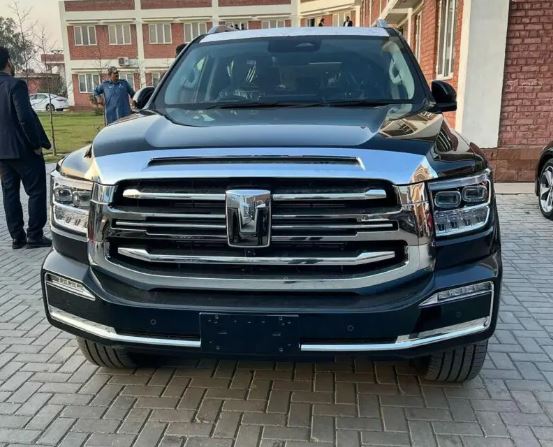
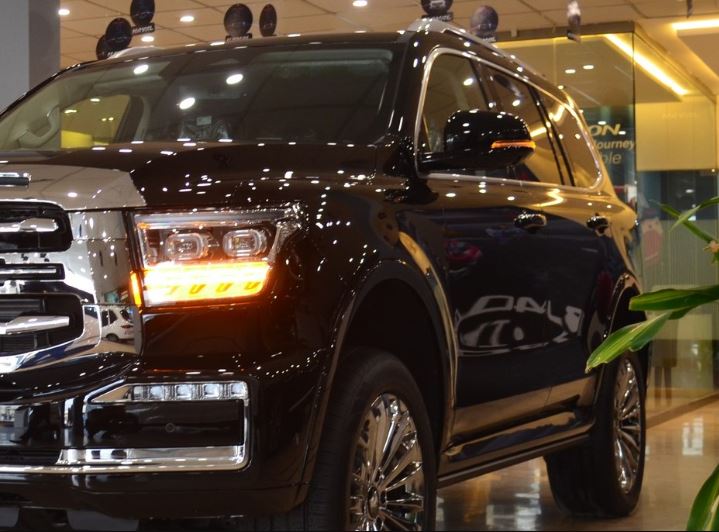
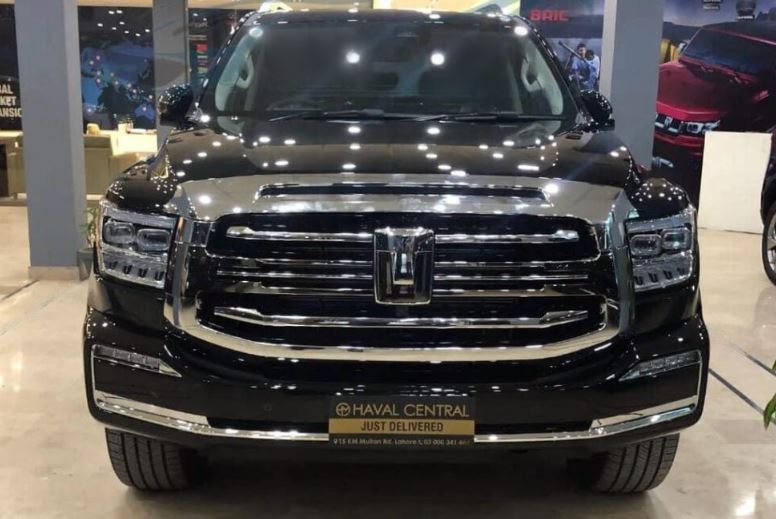
The Tank 500 makes a statement before you even open the door. Measuring 5,078 mm in length, 1,934 mm in width, and 1,905 mm in height, it dwarfs most vehicles on Pakistani roads. The design language is unapologetically bold — a massive chrome-accented grille dominates the front fascia, flanked by modern LED headlights that incorporate distinctive daytime running light signatures.
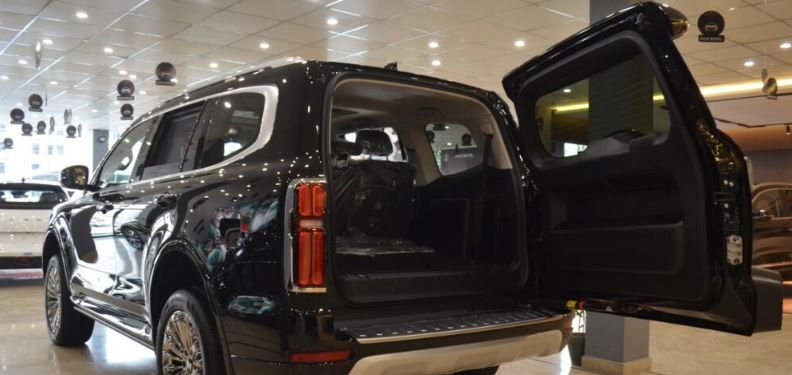
The overall silhouette is boxy and upright, prioritizing interior space and off-road capability over aerodynamic sleekness. Body-colored bumpers, roof rails, and side steps (which electronically deploy when approaching the vehicle) add to the upscale appearance. At the rear, vertical LED taillights and the external spare wheel carrier reinforce the vehicle’s rugged, go-anywhere character.
Ground clearance stands at 213 mm, providing genuine capability for rough terrain while making speed bumps a non-issue — a genuine advantage on Pakistani roads. Approach and departure angles of 29.5 and 24 degrees respectively, with a 22.5-degree breakover angle, indicate serious off-road geometry.
The Tank 500 PHEV is available in two exterior colors: Ivory White and Onyx Black. The black option particularly suits the vehicle’s imposing presence, though white remains popular in Pakistan’s climate for its heat-reflective properties.


Interior Luxury and Technology:
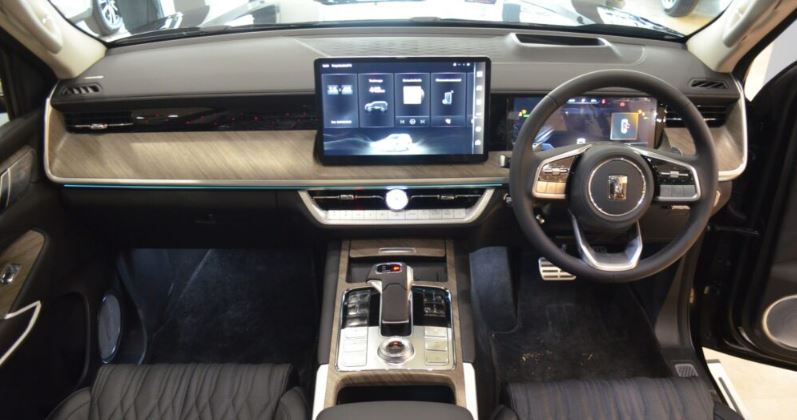
Step inside the Tank 500 PHEV and you’re greeted by an interior that genuinely rivals vehicles costing significantly more. The dashboard is dominated by a massive 14.6-inch touchscreen display running GWM’s infotainment system, complemented by a 12.3-inch digital instrument cluster for the driver. The graphics are crisp, responsiveness is good, and the system supports both Apple CarPlay and Android Auto.
Materials throughout are genuinely premium — soft-touch surfaces, real wood trim inlays, and silver accent pieces create an atmosphere of luxury. The seats feature Nappa leather upholstery with diamond-pattern stitching that extends to the door panels. Both front seats are electrically adjustable and include heating and ventilation functions — welcome features in Pakistan’s extreme climate conditions.
The steering wheel is leather-wrapped with detailed stitching, and a traditional analog clock sits prominently between the air vents — a touch that adds old-world charm to the tech-heavy cabin. Climate controls are managed through a combination of touchscreen and physical buttons, with the latter appreciated for ease of use while driving.
Unlike the HEV variants which offer seven-seat configuration, the PHEV comes exclusively as a five-seater — the battery packaging necessitating this configuration. However, this brings advantages: rear seat passengers enjoy exceptional space and comfort, with dedicated climate controls and seat heating/ventilation. A unique feature is the 7-inch digital display integrated into the center rear armrest, allowing rear passengers to control climate and other functions independently.
Boot space is rated at 646 liters — slightly less than the HEV’s 795 liters due to battery packaging, but still substantial. With rear seats folded, capacity expands to approximately 1,400 liters. The hands-free power tailgate adds convenience when loading luggage.
The audio system features 12 speakers positioned throughout the cabin, delivering good sound quality for music and hands-free calls. Additional touches like ambient lighting with multiple color options, a panoramic sunroof, and wireless phone charging round out the premium experience.



Safety Features & Driver Assistance:
The Tank 500 PHEV comes comprehensively equipped with safety technology. Standard features include six airbags (front, side, and curtain), anti-lock braking with electronic brake-force distribution, traction control, and stability control.
Advanced driver assistance systems include automatic emergency braking, lane departure warning, lane keep assist, blind-spot monitoring, and rear cross-traffic alert. The 360-degree surround-view camera system with selectable viewing angles proves invaluable when maneuvering this large vehicle in tight spaces — a genuine benefit in Pakistan’s congested urban environments.
Off-road specific features include hill descent control, hill hold assist, and a comprehensive off-road information screen displaying pitch and roll angles, differential lock status, tire pressures, and even altitude and air pressure readings. Wade sensing alerts the driver to water depth when fording, with a maximum capability of 800 mm.
The body-on-frame construction provides inherent structural rigidity, while modern high-strength steel construction contributes to crash protection. ISOFIX mounting points are provided for child seats.
Warranty & After-Sales Support:
Addressing common concerns about Chinese vehicle reliability, GWM has backed the Tank 500 PHEV with comprehensive warranty coverage. The battery carries an 8-year or 150,000 km warranty, while the motor is covered for 6 years or 150,000 km. The engine itself receives up to 10 years of coverage — a statement of confidence in the powertrain’s durability.
This warranty structure is notably more comprehensive than what many established brands offer in Pakistan, potentially offsetting concerns about long-term ownership. However, prospective buyers should consider the developing service network — while expanding, GWM’s presence isn’t yet as widespread as Toyota or Honda’s established infrastructure.
Pricing & Value Proposition:
At PKR 22.5 million ex-factory, the Tank 500 PHEV occupies the premium end of Pakistan’s SUV market. This positions it above the Toyota Fortuner (which typically ranges from PKR 15–20 million depending on variant and import status) and in the vicinity of Land Cruiser Prado pricing (though the Prado commands significantly higher prices when imported).
When evaluating value, consider what the Tank 500 offers that competitors don’t: genuine plug-in hybrid capability with substantial electric range, significantly higher power output, more comprehensive equipment levels, and modern design. The comparable specification level from Toyota or other established brands would cost substantially more — if available at all.
However, resale value remains an unknown quantity. Toyota’s dominance in Pakistan’s premium SUV segment is built partly on legendary resale values — a factor the Tank 500 cannot yet match. Early adopters are essentially betting on GWM establishing itself as a credible long-term player in the market.
Real-World User Feedback:
Early owner feedback, gathered from PakWheels forums and direct interactions, reveals generally positive impressions with some caveats. Owners consistently praise the commanding road presence, exceptional interior comfort, and the fuel savings achievable when regularly charged. The smoothness of electric operation and the quietness of the cabin at highway speeds receive particular mention.
Several owners noted that the reality of daily charging requires adjustment — those without home charging infrastructure find the PHEV benefits harder to realize. The sheer size, while appreciated on open roads, presents challenges in congested urban areas and older city centers with narrow streets.
Build quality has received mixed but generally positive reports — panel gaps and interior assembly quality are considered good for the segment, though some owners report minor electronic glitches with the infotainment system. The ride quality on rough roads impresses most testers, with the suspension effectively isolating occupants from Pakistan’s often challenging road surfaces.
The ownership experience appears most satisfying for those with predictable daily routines that fit within the electric range, access to home or workplace charging, and an appreciation for the vehicle’s combination of luxury and capability.
Competitor Comparison:
Against the Toyota Fortuner, the Tank 500 PHEV offers more power, better fuel efficiency when charged, superior interior technology, and more comprehensive equipment. The Fortuner counters with established reliability reputation, vastly larger service network, and stronger resale values.
The Land Cruiser Prado comparison is interesting — the Tank 500 actually exceeds the Prado’s power output while undercutting its price significantly (when comparing to locally assembled or official channel Prados). However, the Prado’s legendary off-road reputation and build quality perception remain strong advantages.
Other competitors like the MG Gloster and Kia Carnival occupy similar price brackets but offer different value propositions — the Gloster emphasizes luxury over off-road capability, while the Carnival prioritizes interior space and versatility as a people-mover rather than an off-roader.
The Tank 500 PHEV carves out a unique position: genuine off-road hardware combined with modern plug-in hybrid efficiency and comprehensive luxury equipment at a price point that undercuts similarly capable and equipped rivals.
Final Thoughts:
The GWM Tank 500 PHEV represents a compelling option for Pakistani buyers seeking a large, capable SUV without the running costs typically associated with the segment. The plug-in hybrid technology genuinely transforms the ownership experience for those who can utilize it — near-silent urban commuting, exceptional refinement, and the ability to undertake long journeys without range anxiety.
For the right buyer — someone with charging access, appreciation for modern technology, and willingness to embrace a newer brand — the Tank 500 PHEV delivers exceptional value. The comprehensive warranty addresses durability concerns, while the equipment levels and performance genuinely embarrass more expensive alternatives.
However, it’s not without compromises. The size demands careful consideration for urban usage, the charging infrastructure requirement adds complexity compared to conventional vehicles, and the long-term resale and service network remain developing stories.
As Pakistan’s automotive landscape evolves and electrification becomes increasingly relevant, the Tank 500 PHEV arrives as a genuinely forward-thinking option that doesn’t sacrifice capability for efficiency — a rare combination that deserves serious consideration from premium SUV buyers.